
2027 Condo Reserve Funding Changes: What Boards Need to Know
A significant change is coming for condominium associations in 2027.
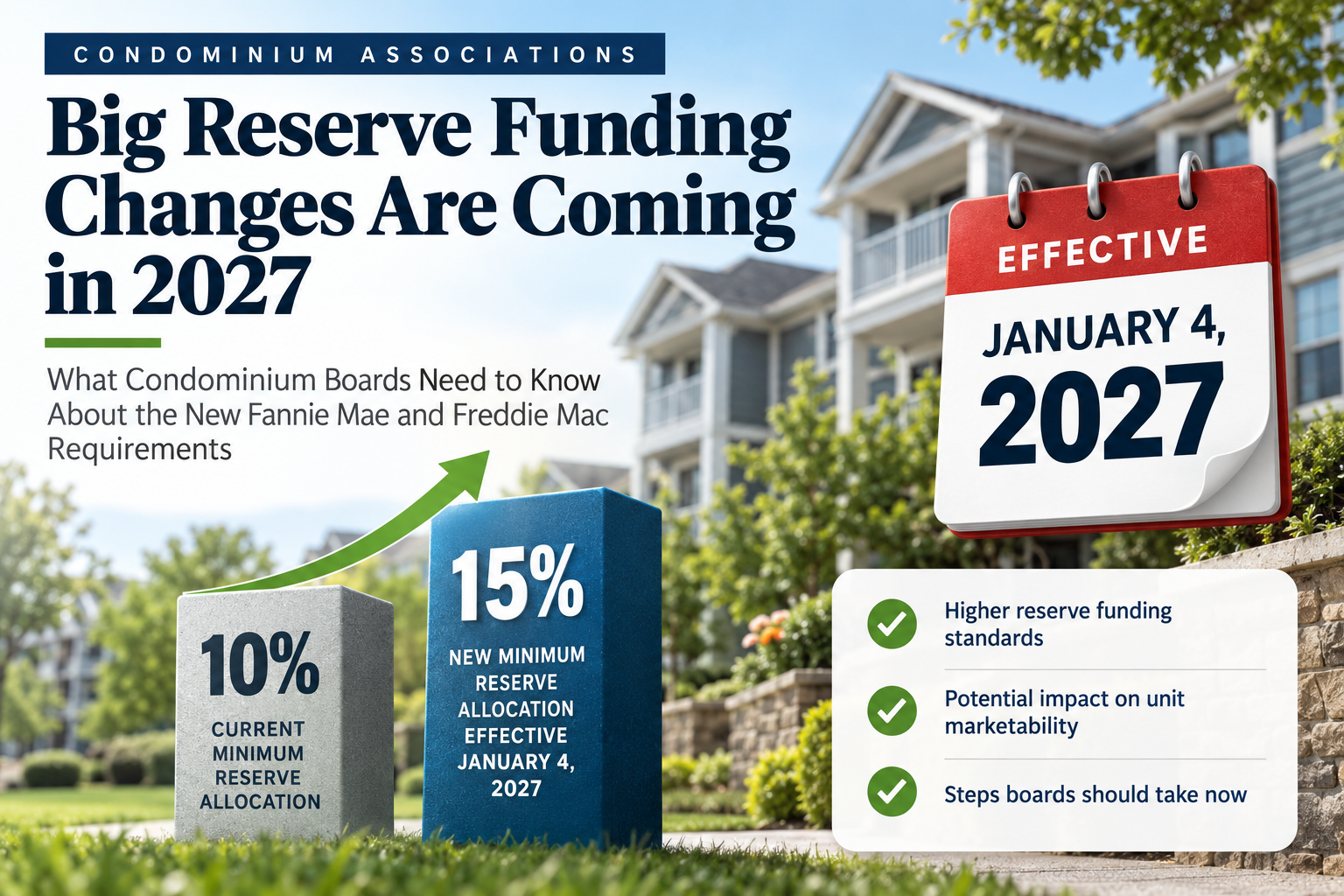
Beginning January 4, 2027, updated Fannie Mae and Freddie Mac condominium lending standards will increase the minimum reserve funding benchmark from 10% to 15% of annual budgeted assessment income for applicable condominium projects.
For condominium boards, this is more than a budgeting issue. An Association’s reserve funding can potentially affect whether buyers are able to obtain conventional financing—and, ultimately, the marketability of units within the community.
Why Is the Reserve Requirement Increasing?
Reserve funds are intended to help associations pay for major repairs and replacements such as roofs, pavement, siding, decks, mechanical systems and other long-term capital components.
The Wall Street Journal has reported that Fannie Mae and Freddie Mac are increasing scrutiny of condominium finances as concerns grow about aging buildings and underfunded reserves.
Under the updated standards, the familiar 10% reserve allocation benchmark increases to 15% beginning January 4, 2027.
For example, an Association with $500,000 in annual budgeted assessment income would move from a $50,000 reserve allocation at 10% to $75,000 at 15%—a difference of $25,000 per year.
Does Every Association Have to Contribute 15%?
Not necessarily.
It is important to distinguish these mortgage eligibility standards from a state law requiring every condominium association to contribute exactly 15% of its budget to reserves.
A qualifying reserve study may support a different contribution level under applicable Fannie Mae and Freddie Mac project standards.
However, simply having a reserve study on file is not necessarily enough. The study must satisfy applicable requirements, remain sufficiently current and support the Association’s funding approach.
Boards should therefore review not only the date of their most recent reserve study, but also its recommended funding levels and whether the Association is actually following those recommendations.
Why Should Unit Owners Care?
Because condominium financing involves more than the finances of the individual buyer.
When a purchaser applies for a conventional mortgage, the lender may also review the condominium project. Reserve funding, insurance, deferred maintenance, critical repairs and other Association-level issues can become part of that review.
If the condominium project does not satisfy applicable lending standards, financing options for a prospective purchaser may become more limited.
That can turn an Association’s reserve funding practices into a unit marketability issue.
What Should Condominium Boards Do Before 2027?
At Northeast Property Group, I recommend that boards begin reviewing this issue now rather than waiting until January 2027.
Boards should review the Association’s current reserve contribution, locate the most recent reserve study, compare actual contributions with the study’s recommendations, and identify upcoming capital projects or deferred maintenance.
Associations without a recent reserve study should also consider whether commissioning an updated professional study is appropriate.
This review is especially important for associations whose fiscal year does not follow the calendar year. Because the new standard takes effect January 4, 2027, those associations should discuss with management and their professional advisors whether their existing budget could require adjustment.
Reserve Funding Is Long-Term Planning
Increasing reserve contributions can be difficult. Boards are understandably concerned about keeping common charges affordable.
But reducing reserve contributions does not eliminate the underlying capital expenses.
Roofs still need replacement. Roads deteriorate. Buildings require painting and siding work. Mechanical systems eventually fail.
Connecticut community-association guidance generally places responsibility for maintaining, repairing and replacing common elements with the Association, subject to the governing documents and applicable exceptions.
The question is therefore often not whether owners will ultimately pay for major capital projects, but how and when those costs will be funded.
Adequate reserves allow costs to be accumulated over time. Inadequate reserves can contribute to large special assessments, borrowing or deferred projects.
Start Planning Now
January 2027 will arrive quickly in terms of Association budgeting.
Reserve studies take time. Boards need an opportunity to review recommendations, evaluate future projects, consider common-charge implications and communicate changes to owners.
Northeast Property Group recommends that condominium boards begin reviewing their reserve funding strategy as part of their 2027 budget planning.
The goal should not simply be to reach a particular percentage. The goal should be a responsible, supportable reserve funding plan that addresses the Association’s actual capital needs while recognizing the lending standards that can affect owners’ ability to sell and refinance their units.
Northeast Property Group, Inc. works with condominium and homeowners associations throughout Connecticut and Rhode Island to develop budgets, coordinate reserve studies and plan for long-term capital needs.
For assistance reviewing your Association’s reserve funding and preparing for 2027, contact Northeast Property Group, Inc. at (860) 437-7005.
This article is provided for general informational purposes only and is not legal, accounting, lending or financial advice. Lending standards are subject to change, and associations should consult appropriate legal, financial and reserve professionals regarding their particular circumstances.
